
The famed RAF roundel originated in late 1914 when the RFC adopted a version of the French insignia. However, it was not until mid-1915 that the practice became official and complete throughout the service. RFC aircraft were originally marked with serial numbers only with pilots applying their own markings at squadron level painting British flags on the wings and fuselage. However, there was a high risk of friendly fire incidents with the George Cross being mistaken for the German iron cross. To keep a similar theme to their French Allies, the RFC modified the French cockade as a roundel with the colours reversed. The French had red on the outer circle, white middle and French blue on the inner. The official British version had the familiar outer blue band with white middle and a red centre, equal width ratio 1:3:5. The roundel was applied to the upper and lower wings and either side of the fuselage. Initially the roundel filled the whole width of the wing and positioned as close to the wingtip as possible. A tail flash was also applied of red, white and blue, usually painted vertically across the rudder section, with the blue bar on the hinge side in the same manner as the French tricolour. By 1917 a thin white band was added to the outer ring to accentuate the blue and to distinguish between the darkness of the doped linen PC.10 and PC.12 colours. Also, in 1916 a need to reduce the visibility of aircraft operating at night led to the roundel having the white overpainted in the dope colour or red. By 1917 the night roundel was standardised with blue and red which was used post war on all night fighters and bombers.
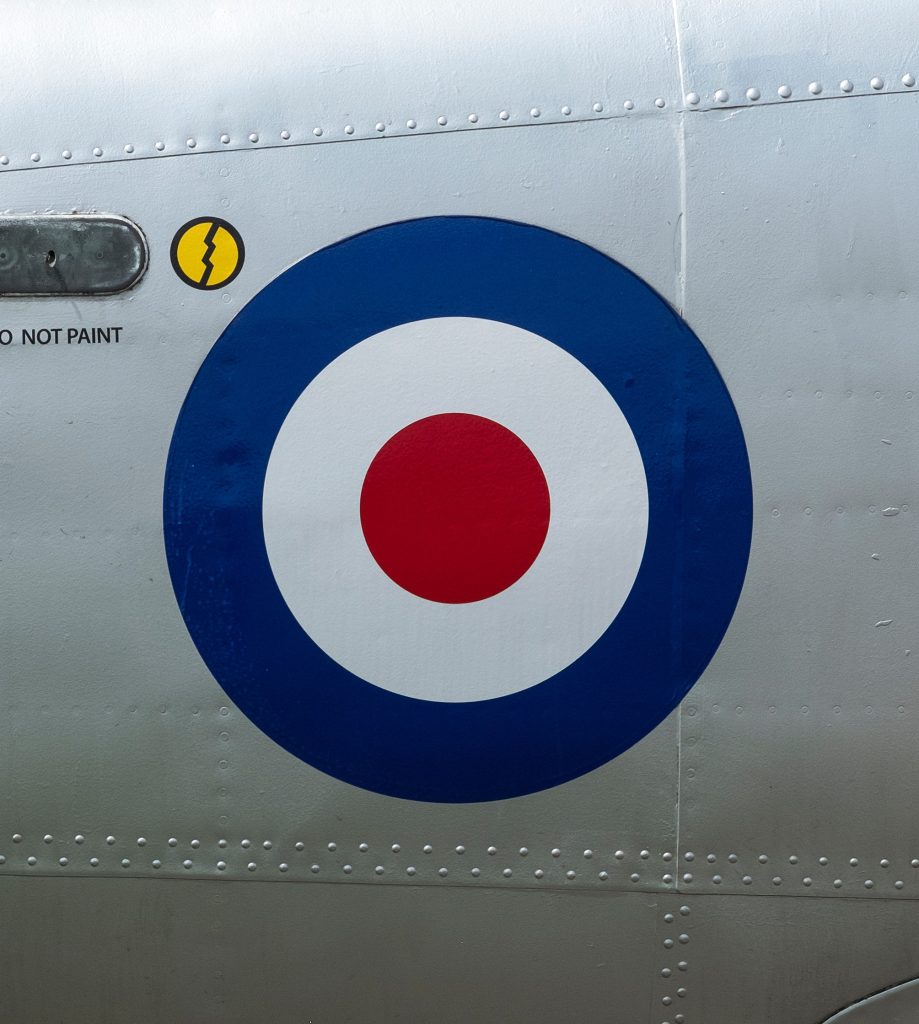
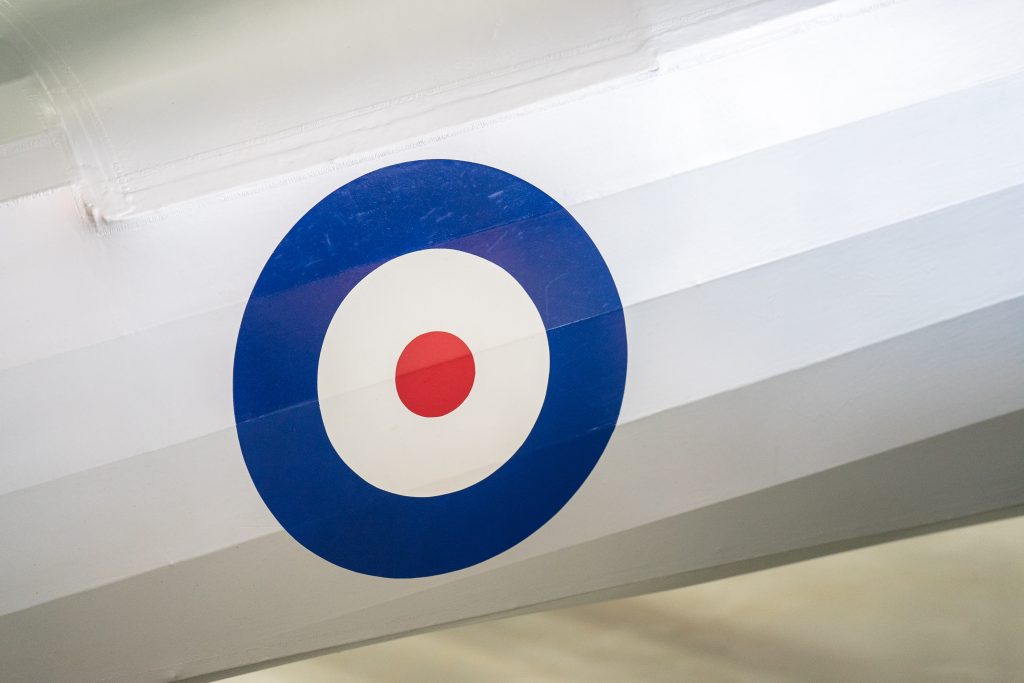
The RNAS initially adopted a white circle with a red outer ring on the upper wing until the roundel was standardised across the services in June 1915. The roundel became the official national identification version when the RAF formed in 1918.
Post war aircraft roundels were slightly modified. After the war the requirement for camouflage became unnecessary and all aircraft were finished in bare metal or aluminium with aluminium doped linen surfaces. The tail flash was moved to the tail fin before being removed completely. The roundel lost the outer white ring and was reduced in overall size to avoid covering the flight control surfaces. Between 1919 and 1929 the roundel remained unchanged. It became known as type A. The darker roundel applied to night operated aircraft with the blue and red circle became known as type B. The type A was changed in 1929 with same ratio, but the colours were more saturated, officially known as Identification Blue and Identification Red. A duller version of this was used on under wing surfaces and light surfaces until 1942.
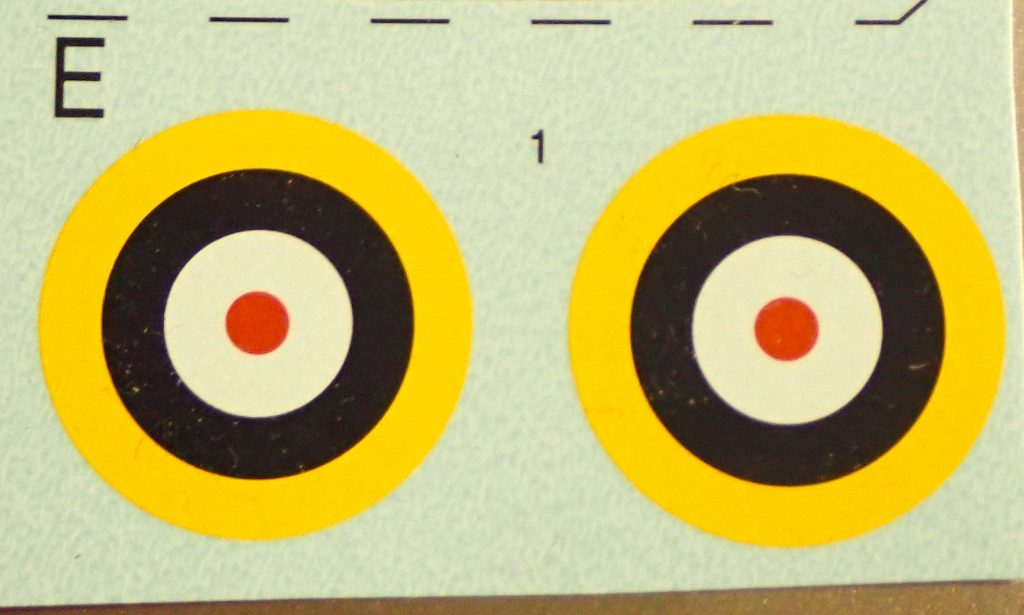
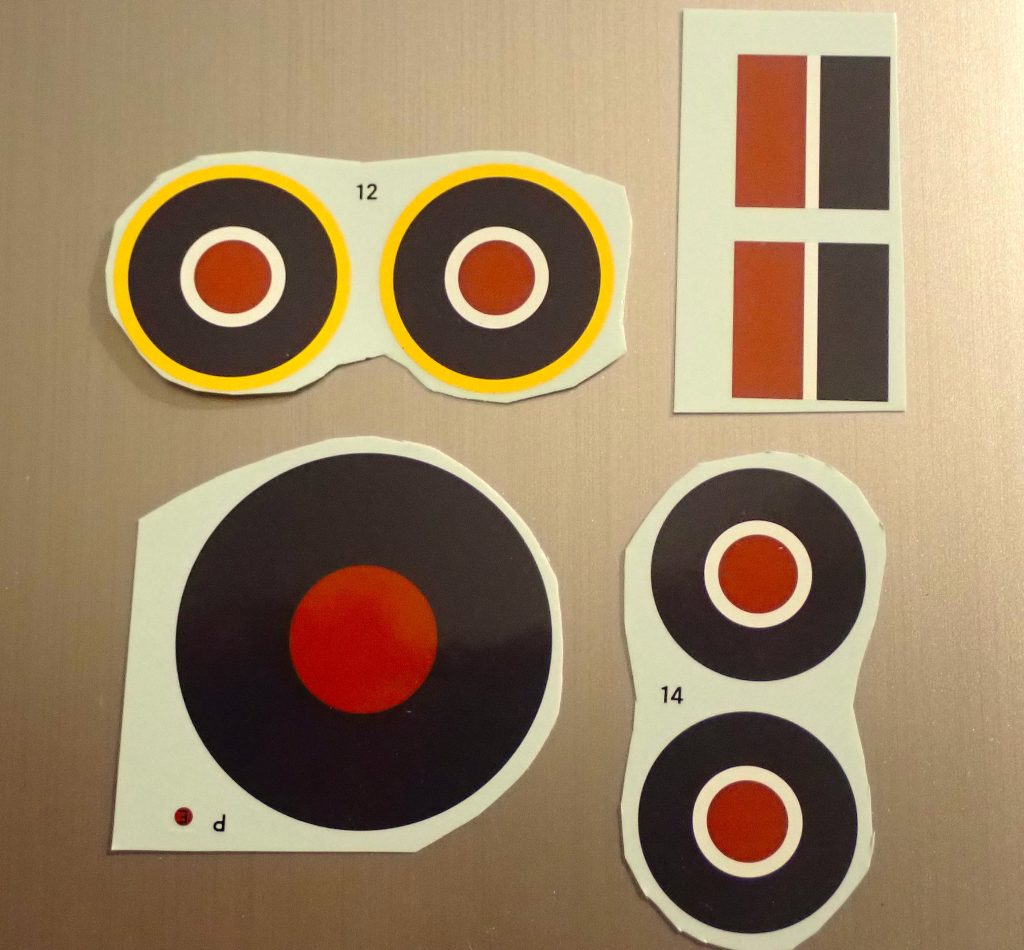
With the reintroduction of camouflage in the mid to late thirties a new set of roundels were introduced. The type A was modified with a thicker yellow band around the outside in a ratio of 1:3:5:7 from 1937 to 1939 on camouflaged surfaces. In 1939 it was applied to fuselage sides only until 1942. (This was also applied to ground vehicles in the UK and North Africa and Middle East for aerial identification between 1942 and mid-1943). An alternative to the A.1, the A.2 was also applied to some aircraft from 1940 to 1942 with a thinner yellow band. In early 1940 a standard tail flash was re-introduced which was modified to a large or small rectangle, on the tail upright instead of the rudder, with a 1:1:1 ratio of red, white and blue but now with the red on the forward-facing side.
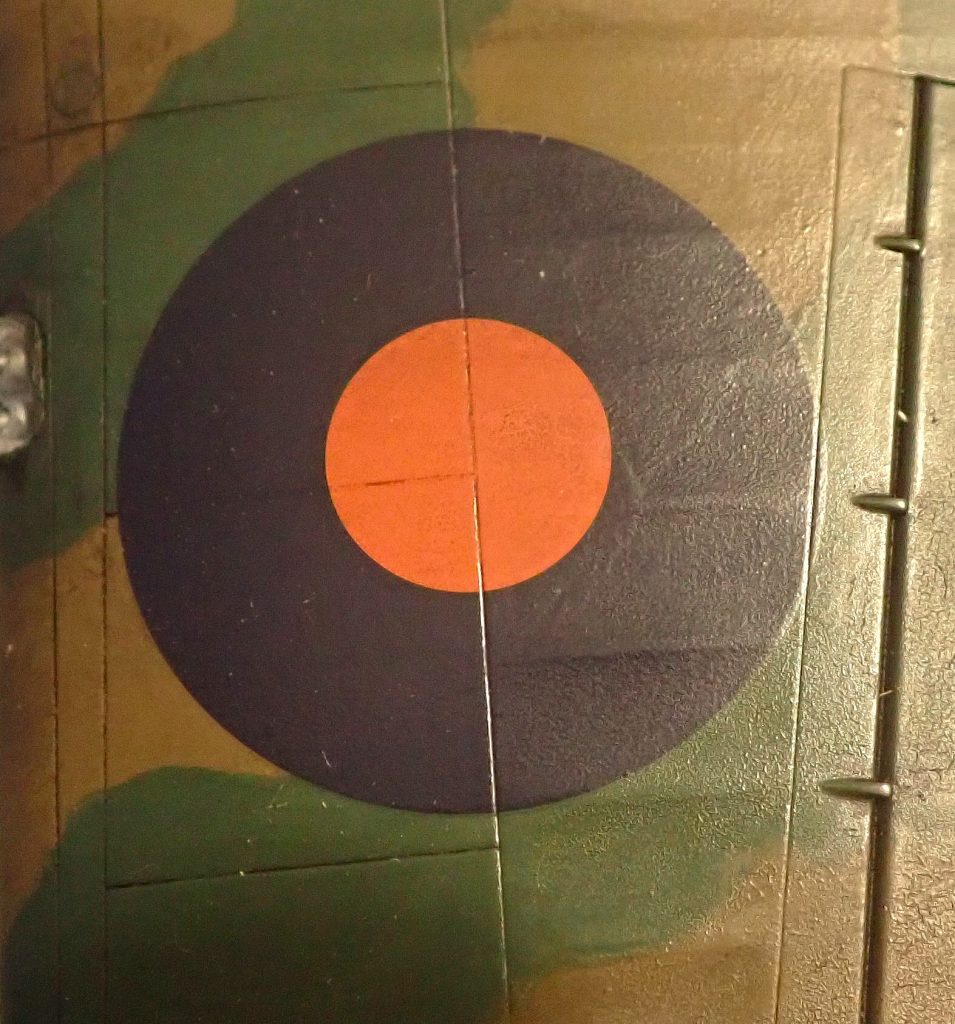
Type B roundel with a 2:5 ratio of blue and red was used on night aircraft from 1918 on all positions. It was used on all NIVO coated planes from 1923 until 1939. NIVO stood for ‘Night Invisible Varnish Orfordness’ which was an overall dark grey/green, also known as black green, painted on all the inter-war bombers. However, it was proved too reflective with searchlights and was withdrawn in the mid-1930s. By the time the twin engined monoplane medium bombers were introduced the non-reflective ‘Special Night’ was in use. By 1938 the type B was only used for upper surfaces of the wings with the type A.1 and A.2 being used on the fuselage of camouflaged aircraft. Night aircraft continued with the use of type B with the sides being type B.1, a type B with a wide yellow outer circle. Some aircraft used the type A with the white blacked out or painted the camo colour.
From July 1942 a new type C and C.1 were introduced for underwing and fuselage use with the type B for upper wing. The type C was red, white and blue with a much thinner white ring in 3:4:8 ratio with the C.1 the same but with a thin yellow band around the outer rim in 3:4:8:9 ratio. The tail flash was half and half blue and red with a thin white stripe separating the two. This was pretty much standardised throughout the RAF and FAA during the latter half of WW2 in most theatres. The South East Asia Command or SEAC used a modified type C.1, with the red centre removed to avoid confusion with Japanese aircraft, briefly in 1942 until the introduction of the SEAC roundel in mid-1942. This was a 2:5 ratio of blue with a light blue (50% Identification Blue and 50% White) centre ring on all surfaces. The rear tailfin flash was rectangular with half and half same colours, dark blue to the rear. All were approx. 50% smaller than the normal insignia. The East Indies Fleet and later the British Pacific Fleet carrier aircraft used varying versions of roundels with blue and white only until the adoption of the American type, blue roundel with a white centre and a thin white outer ring with a white rectangular flash either side with a blue border. No tail flash was applied.
After the war most retained the standard of Type C, C.1 and B with some aircraft using the type C.1 in all locations (notably on the Tempest, Supermarine Seafang and Spiteful) until 1947 when the type D roundel was introduced with a wider red centre and thinner outer blue ring, much the same as type A but with a 1:2:3 ratio. This roundel type is still in use today. A faded version of this type was used on Anti-Flash White colour schemes of tactical nuclear strike aircraft and V bombers. The FAA retained the roundels but dropped the tail flash.
A new low visibility roundel based on the type B came into use in the 1970s on all camouflaged aircraft in all positions with a 1:2 ratio. A faded version of this type was used on all superiority grey colour schemes from the early 1980s with roundel and tail flash official colours being salmon pink and baby blue.
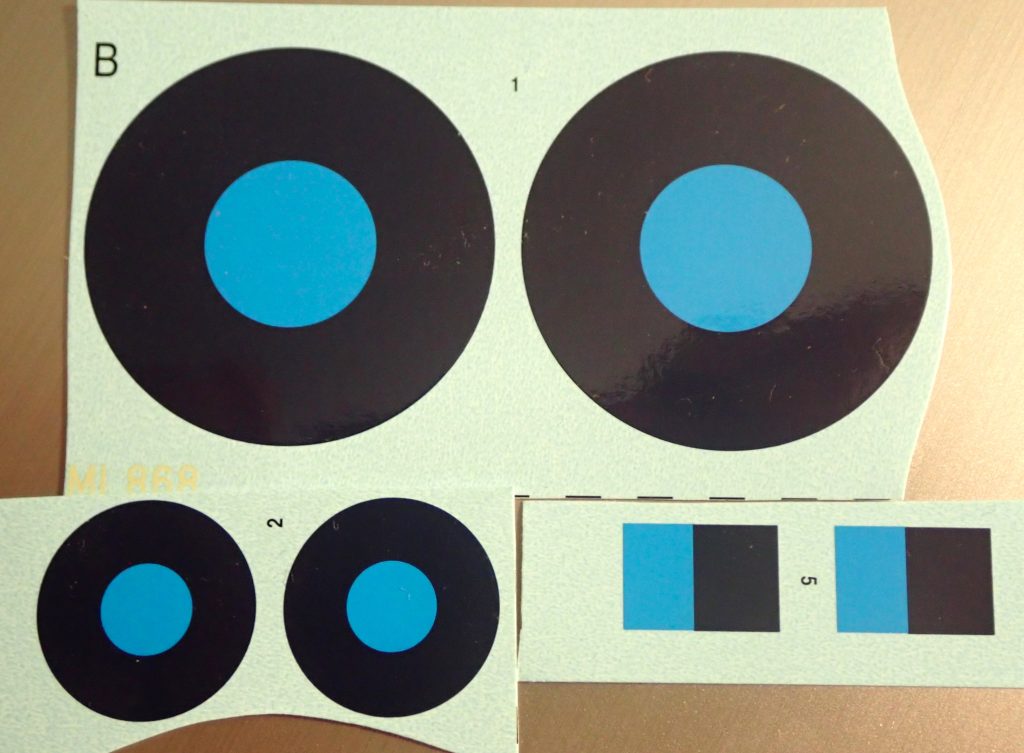
The current low visibility roundel is a somewhat lacklustre low-vis standard used exclusively on the F-35 Lightning II, still with a 1:2 ratio but smaller in size. The inner circle is the same dark grey as the airframe with the outer ring a lighter ocean grey. The tail flash is the same colours displayed as an italic rectangle, the lighter grey representing the red. These insignia are installed in the airframe during manufacture as opposed to being painted.
There were several cases where standards were not conformed to resulting in many anomalies, especially during inter-war years and with the introduction of colourful squadron flashes applied either side of the roundels. During WW2 a little more conformity was observed but there were widespread inconsistences when transitioning between roundel types. Vintage photographs are invaluable.
Positioning of the insignia varied throughout the history of the RAF depending on the period. As a general rule of thumb, the fuselage roundels appeared at the central rear section until after WW2. Variations in size and position of upper and lower wing roundels varied between types of aircraft. After 1947 roundels were positioned in different locations depending on the aircraft type as jets differed with the standard layout of piston driven aircraft. Upper and lower wing roundels stayed, but fuselage roundels were more pronounced on intake or nose positions during the 1960s, 1970s and 1980s on camouflaged aircraft, again with some exceptions.
FAA aircraft followed much the same as the RAF with some exceptions. However, the Royal Navy and Army aircraft had no tail flash with just ROYAL NAVY and the serial number, or ARMY written somewhere on the rear fuselage. Helicopters tended to have pronounced service identification and less conspicuous roundels.